Top Baler Machine Manufacturer
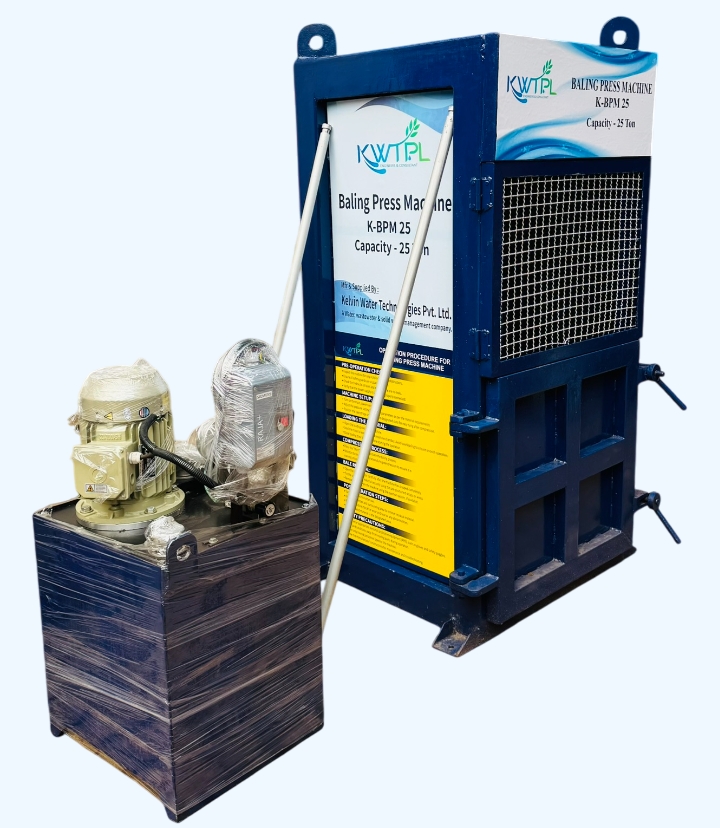
Baler machines are the backbone of efficient waste handling and recycling operations across industries. From packaging firms and e-commerce warehouses to municipal recycling centres and large-scale manufacturing units, balers compact recyclable materials into dense, transportable bales. This article explains what makes a baler manufacturer “top-tier,” key baler types and features, selection criteria, and highlights Kelvin Water Technologies’ role in integrated zero-waste solutions.
Why choosing the right baler manufacturer matters?
Selecting a reputable baler manufacturer is about more than buying robust equipment. It’s about investing in long-term operational efficiency, safety, serviceability, and sustainability. The right manufacturer offers:
- Proven reliability and uptime — machines that run consistently with minimal downtime.
- After-sales support — local spare parts, swift service, technicians, and training.
- Safety and compliance — machines designed to meet industry safety standards and local regulations.
- Customization — ability to match throughput, bale size, and material types specific to your process.
- Total cost of ownership— not just purchase price but energy consumption, maintenance costs, and residual value.
Main baler types and common applications
Understanding baler types helps match the machine to your material and throughput needs.
1. Vertical balers
- Best for low- to medium-volume operations (retail, small warehouses, grocery stores).
- Footprint-friendly, operator-fed; ideal for cardboard, paper, and light plastics.
2. Horizontal (or automatic) balers
- Designed for high-volume recycling centres, manufacturing plants, and logistics hubs.
- Can be fully automated with conveyors and feed systems for continuous processing of cardboard, plastics, and textile fibers.
3. Two-ram balers
- Heavy-duty units for dense materials like PET, mixed plastics, or metal scrap.
- Provide high compaction force and faster bale formation for demanding environments.
4. Industrial balers (closed-door, chambered)
- For large-scale operations needing consistent, tightly bound bales for transport and export.
5. Specialty balers
- Designed for unique materials (aluminum cans, agricultural waste, textile offcuts) or for integrating with downstream processes (shredders, conveyors).
Key technical features to evaluate
When comparing manufacturers and models, prioritize these features:
- Tonnage/Compaction Force: Determines bale density and processing capability. Higher tonnage = denser bales and higher throughput.
- Bale Size & Weight: Match to transport logistics and material handling equipment.
- Cycle Time: Faster cycles raise throughput for busy facilities.
- Automation & Controls: PLCs, HMI touchscreens, programmable cycles, remote monitoring and diagnostics reduce operator error and speed troubleshooting.
- Energy Efficiency: Look for hydraulic systems with efficient pumps, soft-start controllers, or variable frequency drives to lower energy consumption.
- Safety Systems: Interlocks, emergency stops, guarding, and safe lockouts are essential.
- Build Quality & Materials: Heavy-duty steel framing and high-grade hydraulic components extend service life.
- Serviceability: Ease of access to wear parts, modular components, and clear maintenance schedules reduce downtime.
- Certification & Compliance: CE, ISO, or local safety certifications indicate manufacturer adherence to standards
Buying guide: matching your needs
- Audit your material stream: What materials (cardboard, PET, mixed plastics, textile waste) and how many tons per day?
- Calculate throughput: Estimate daily bale volume to determine vertical vs horizontal and cycle-time requirements.
- Decide on automation: Manual balers reduce capital expense; automated lines reduce labor and increase throughput.
- Plan for space & logistics: Consider bale storage, forklift access, and transport routes.
- Assess service coverage: Ensure the manufacturer or distributor has parts and technicians reachable within your region.
- Request references & site visits: See machines running in similar operations and ask for performance data.
- Factor in lifecycle costs: Include energy use, spare parts pricing, warranty terms, and trade-in/resale value.
Why after-sales support separates the leaders?
Baler performance is intimately tied to the manufacturer’s service ecosystem. Leading manufacturers offer:
- Scheduled maintenance programs
- On-site training for safe operation
- Remote diagnostic tools and firmware updates
- Readily available spares and consumables
- Retrofit and upgrade paths (e.g., adding automation or IoT connectivity)
Sustainability and circular-economy value
Balers are critical enablers of recycling and material reuse. Dense, uniform bales reduce transport emissions per tonne, lower contamination, and increase material value to recyclers. Modern baler designs that reduce energy use, utilize recyclable components, and integrate with overall waste management systems contribute significantly to corporate sustainability targets and regulatory compliance.
Kelvin Water Technologies — integrated approach to zero waste
Kelvin Water Technologies is a company known for providing environmental engineering solutions, particularly in sewage and wastewater treatment and zero-waste management systems. While traditionally recognized for compact STPs and effluent management equipment, Kelvin Water Technologies has expanded its portfolio to support holistic waste and resource recovery strategies that include solid waste processing and baling solutions as part of complete zero-waste offerings.
What sets Kelvin Water Technologies apart in this space:
- Systems thinking: They design solutions that integrate sewage treatment, organic waste processing (composters, in-vessel systems), and solid waste handling into cohesive flows — reducing cross-stream contamination and improving overall resource recovery.
- Customization for local conditions: Kelvin tailors equipment and process design to suit residential complexes, institutional campuses, commercial facilities, and light industrial sites, which often require compact, low-noise balers and material-handling solutions.
- Compliance and end-to-end support: Their background in environmental compliance (STP/ETP) means they can help clients align baling and recycling operations with discharge regulations, waste management rules, and sustainability reporting.
- Zero-waste focus: As organizations move toward circular models, Kelvin’s multi-product approach helps customers close the loop — for example, combining composting of organics with baling of recyclables for efficient segregation and value recovery.
Final thoughts
Top baler machine manufacturer combine rugged mechanical design with smart controls, energy efficiency, and global/local service networks. The right choice depends on your material types, throughput needs, automation goals, and sustainability objectives. For organizations seeking integrated environmental solutions — where wastewater treatment, organic processing, and solid waste baling are coordinated — companies like Kelvin Water Technologies offer a systems-engineering approach that can simplify vendor management and improve end-to-end resource recovery.