STP Turnkey Solution
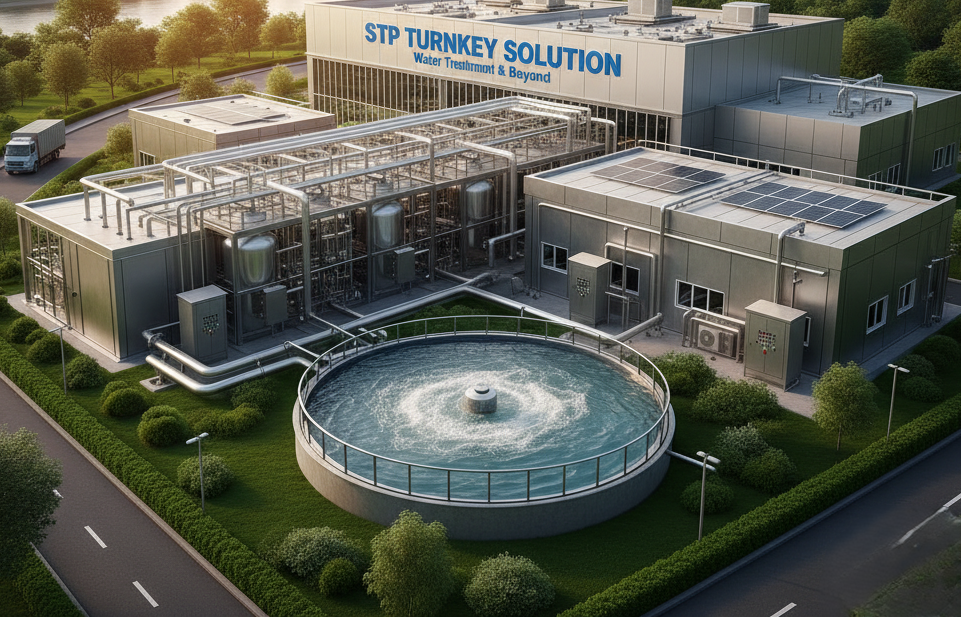
Managing wastewater efficiently is one of the biggest priorities for modern residential complexes, industries, commercial buildings, and institutions. As environmental regulations become stricter, organizations are shifting toward solutions that ensure compliance without operational hassle. This is where a STP turnkey solution proves to be the most reliable option. It offers a fully integrated approach—from concept and design to installation and commissioning—making wastewater treatment smooth, efficient, and worry-free.
What Is an STP Turnkey Solution?
A STP turnkey solution refers to delivering a sewage treatment plant that is ready for immediate operation. Instead of coordinating with multiple contractors for civil work, mechanical components, electrical systems, automation, and commissioning, a turnkey provider handles everything under one roof.
The client receives a fully installed, tested, and optimized wastewater treatment system that meets all regulatory and environmental standards.
Why Turnkey Solutions Are Becoming Popular?
Turnkey STP systems eliminate delays, confusion, and project mismanagement. They offer a structured and professional approach, ensuring that clients don’t have to deal with technical complexities.
Some key advantages include:
1. One-Stop Project Execution
The entire project—from planning to commissioning—is managed by a single expert team.
2. Faster Completion
Turnkey firms follow standardized procedures, completing projects more efficiently.
3. Cost Optimization
Material purchase, labour management, and design execution are streamlined, reducing unnecessary expenses.
4. Compliance Guarantee
Professional turnkey providers ensure the plant meets CPCB and SPCB wastewater discharge norms.
5. Reduced Operational Burden
Clients don’t need to worry about coordination, quality checks, or technical troubleshooting.
Stages of a Professional Turnkey STP Project
A high-quality STP turnkey solution includes several coordinated steps:
1. Requirement Assessment
Experts analyze sewage load, available space, water usage, and future expansion plans.
2. Process and Hydraulic Design
Engineers develop a customized layout based on selected technology such as MBBR, MBR, SBR, or ASP.
3. Civil Construction
Construction of tanks, foundations, pipelines, drains, and structural elements.
4. Mechanical Installation
Setting up pumps, blowers, diffusers, screens, clarifiers, agitators, and filtration units.
5. Electrical and Instrumentation
Control panels, wiring, sensors, automation systems, and safety devices are installed.
6. Control System Integration
SCADA-based automatic control systems, alarms, flow meters, and remote monitoring may be added.
7. Plant Commissioning
The plant is tested, calibrated, and evaluated for performance and compliance.
8. Operator Training & Handover
The client’s team is trained on operations, safety, and preventive maintenance before handover.
Modern Technologies Used in Turnkey STP Projects
A reliable STP turnkey solution includes selecting the right treatment technology based on space, inflow characteristics, and treated water goals. Popular technologies include:
• MBBR (Moving Bed Biofilm Reactor): Compact and ideal for residential and commercial buildings.
• MBR (Membrane Bioreactor): Provides high-quality treated water suitable for reuse.
• SBR (Sequential Batch Reactor): Efficient and widely used in urban and industrial systems.
• ASP (Activated Sludge Process): A traditional and stable treatment mechanism suitable for large-scale use.
• Hybrid Systems: Combination of multiple technologies for enhanced efficiency.
Where Turnkey STPs Are Commonly Used?
Due to their convenience and reliability, turnkey STPs are widely installed in:
- Residential apartments & gated communities
- Industries & manufacturing plants
- Hospitals and healthcare institutes
- Hotels, resorts, and restaurants
- Commercial complexes, IT parks, and malls
- Schools, colleges, and universities
- Municipal and government wastewater systems
General Treatment Flow in a Turnkey STP
A well-designed STP turnkey solution follows a structured treatment sequence:
1. Screening & Pre-Treatment: Large solids, plastics, and floating materials are removed.
2. Equalization & Primary Settling: Wastewater is equalized and suspended particles begin settling.
3. Aerobic or Anaerobic Biological Treatment: Microorganisms break down organic pollutants to purify the water.
4. Secondary Clarification: Sludge settles at the bottom and clear water rises to the top.
5. Filtration & Disinfection: Processes like sand filtration, carbon filtration, UV, or chlorination ensure safe water.
6. Sludge Management: Sludge is dewatered and disposed of in an eco-friendly way.
7. Reuse or Safe Discharge: Treated water is used for gardening, flushing, cooling towers, or safe disposal.
Long-Term Benefits of Choosing a Turnkey STP Provider
Organizations prefer turnkey installation because it provides:
• Full accountability: One company is responsible for performance, quality, and warranty.
• High-quality components: Reliable equipment ensures long life and lower breakdown rates.
• Lower maintenance requirements: Standardized engineering and automation reduce operational challenges.
• Sustainability: Helps achieve environmental targets, reduce water bills, and reuse water effectively.
Conclusion
A STP turnkey solution is one of the most efficient ways to set up a sewage treatment plant without dealing with multiple vendors or technical complications. It ensures smooth project execution, better design quality, high reliability, and complete compliance with environmental standards.
For residential societies, commercial buildings, hotels, hospitals, and industries, a turnkey STP offers value, efficiency, and long-term sustainability. If you want a wastewater treatment system that is optimized, durable, and ready to operate from day one, choosing a turnkey solution is the smartest decision.